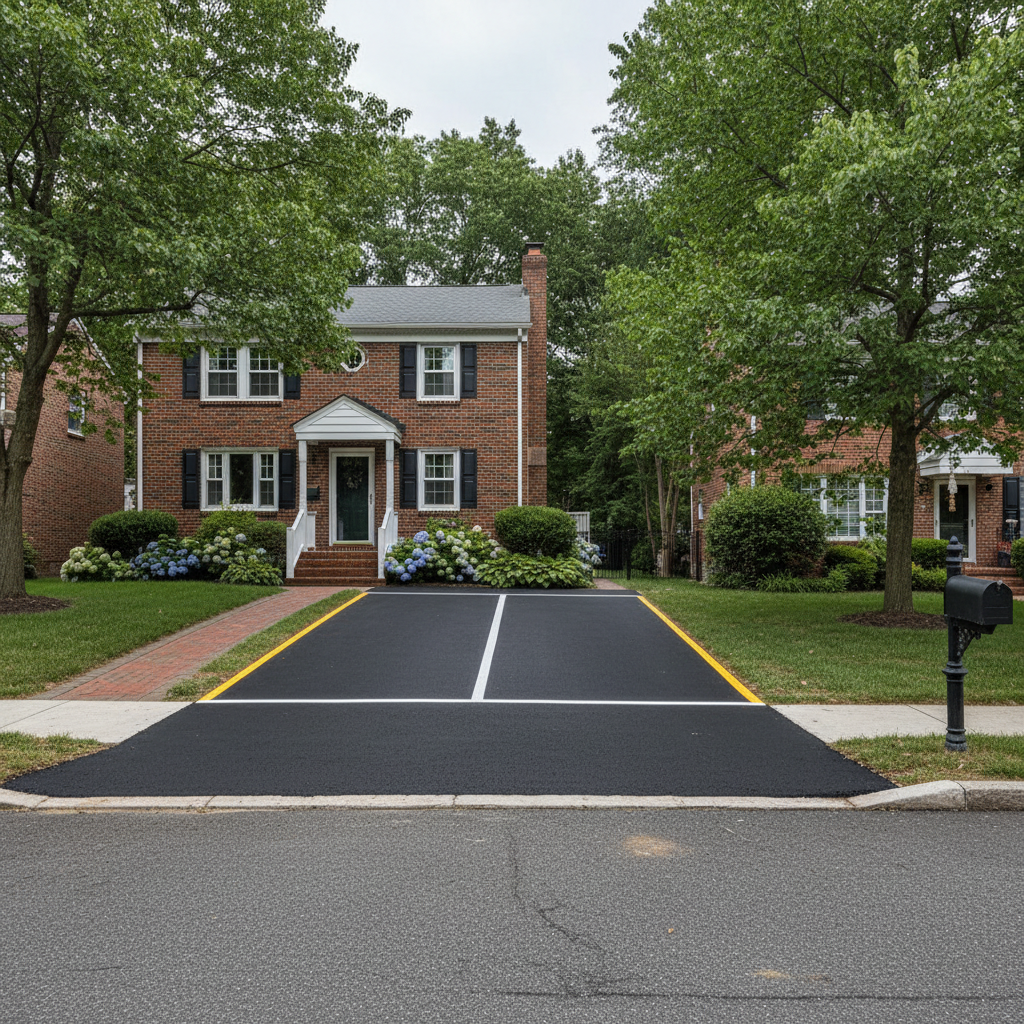
So, you need your parking lot lines redone, huh? Or maybe it's a brand new lot and you're trying to figure out what the striping will cost. Either way, you're probably asking, "What's this going to set me back?" It's a fair question, and one I get all the time here at Apex Asphalt Co. I'm not going to give you some vague "it depends" answer. Let's talk real numbers for Philadelphia.
What Makes Striping Prices Go Up or Down?
A few things really decide the final price tag for parking lot striping. It's not just about how many lines there are; it's actually more complex than that. Here's what we look at:
The Size and Layout of Your Lot: This is probably the biggest factor. A small, simple lot with just a few spaces is obviously cheaper than a sprawling shopping center lot with hundreds of stalls, directional arrows, and pedestrian crossings. More lines, more paint, more labor, you get the idea.
Existing Conditions (New Layout vs. Restripe): Is this a brand new lot that needs a fresh layout? That takes more time for precise measurements and snapping chalk lines. Or are we just repainting faded lines? Restriping is generally quicker and therefore less expensive because the old lines act as a guide. If the old lines are barely visible, though, it's closer to a new layout job.
Type of Paint: We primarily use traffic paint, but there are different grades. Standard acrylic latex is common, but some jobs might need more durable, faster-drying, or reflective paints, especially for high-traffic areas or specific safety requirements. Higher-grade paints cost more.
Number of Colors: Most lots are just white and yellow. But if you need blue for handicap spots, red for fire lanes, or even green for EV charging, each extra color adds a bit to the cost due to more setup and cleanup time.
Complexity of Markings: Straight lines are one thing. But if you need stenciled words (STOP, FIRE LANE, RESERVED), handicap symbols, directional arrows, or custom logos, that's more intricate work and takes more time, driving up the price.
Site Preparation: Is the lot clean and ready to go? Or do we need to sweep debris, pressure wash, or even remove old, conflicting paint lines? Any prep work adds to the labor cost.
Accessibility and Timing: Can we get in and out easily? Do we have to work around your business hours, like doing the job at night or on a weekend? Off-hours work often comes with a premium.
Typical Striping Costs in Philadelphia
Alright, let's get to some actual numbers. Remember, these are general ranges, but they'll give you a solid idea.
Basic Parking Stall Lines: For a standard 9-foot wide parking stall line (about 18 feet of paint per stall, two lines), you're typically looking at anywhere from $3.00 to $6.00 per linear foot. So, if a stall needs two 18-foot lines, that's 36 linear feet, costing you around $108 to $216 per stall. This is for repainting existing lines. New layouts will be on the higher end of that range, sometimes a bit more.
Handicap Symbols: These are stenciled, so they take more time. Expect to pay between $75 to $150 per symbol, depending on size and how complex it is.
Stenciled Words (STOP, FIRE LANE, etc.): Similar to handicap symbols, these run about $50 to $120 per word, again, depending on size and number of letters.
Arrows (Directional): A standard directional arrow usually costs between $40 to $80 each.
Curb Painting: If you need curbs painted yellow for no parking zones or red for fire lanes, that's typically priced per linear foot, often around $1.50 to $3.00 per linear foot.
Minimum Job Charge: For smaller jobs, like a tiny four-car lot or just a few handicap spots, most reputable contractors, including us, will have a minimum charge. This covers mobilization, setup, and cleanup. In Philly, that minimum is usually in the range of $400 to $750.
So, a small lot in South Philly with 20 spaces, a couple of handicap symbols, and a "STOP" stencil might run you anywhere from $2,500 to $4,500. A larger commercial lot with 100 spaces, multiple arrows, and fire lanes could easily be $8,000 to $15,000 or more. Just think of those big box stores!
What Should a Quote Include?
When you get a quote from Apex Asphalt Co or any other outfit, make sure it's detailed. It shouldn't just be a single number. You want to see:
Scope of Work: A clear description of what's being done. "Restripe 50 parking stalls," "Paint 2 handicap symbols," "Install 3 directional arrows."
Materials: What type of paint are they using? Is it standard, or a higher-grade material?
Preparation: Does it include sweeping, blowing off debris, or any other necessary prep?
Timeline: When can they start? How long will it take?
Total Cost: Obviously, the final price. Make sure it's all-inclusive, no hidden fees.
Insurance and Licensing: Any legitimate contractor should be able to provide proof of insurance and proper licensing. Don't skip this, especially in a city like Philadelphia where you want to be sure you're covered if something goes wrong.
How to Avoid Overpaying for Striping
Nobody wants to get ripped off, right? Here's how you can make sure you're getting a fair deal:
Get Multiple Bids: This is standard practice for any service. Get at least three quotes. It helps you compare not just price, but also the proposed scope of work and the contractor's professionalism.
Be Clear About Your Needs: Don't just say "I need my lot stripped." Provide a diagram, or walk the lot with the contractor and point out exactly what you want. The more specific you are, the more accurate the quote will be.
Ask About the Paint: Cheaper paint fades faster, especially with our Philly winters and the salt and brine we put down. Make sure they're using a quality traffic paint that'll hold up.
Check References and Reviews: See what other businesses in the area say about them. A good reputation speaks volumes.
Don't Always Go for the Absolute Cheapest: There's a reason some bids are significantly lower. It could mean lower quality paint, cutting corners on prep, or inexperienced crews. You want a good value, which isn't always the lowest price.
Ultimately, a well-striped parking lot isn't just about how it looks; it's about safety and efficiency for your customers and employees. It's an investment that pays off. Do your homework, ask the right questions, and you'll get a great job done without breaking the bank.